


 Patrick Zeis
 Through his landmark 1995 bestseller Emotional Intelligence, Daniel Goleman fundamentally reshaped the conversation around human potential and success, arguing that qualities such as self-awareness, emotional regulation, empathy, and interpersonal skills often matter as much as—if not more than—traditional measures of intelligence. Drawing on his background as a psychologist, Harvard-trained scholar, and science journalist for The New York Times, Goleman helped bring complex psychological research into the mainstream with unusual clarity and accessibility. Beyond his influential work on emotional intelligence, he has played a pivotal role in the development of contemplative science, helping foster dialogue between leading Buddhist teachers and Western researchers in the scientific study of meditation and human flourishing. A two-time Pulitzer Prize nominee and author of numerous bestselling books, Goleman remains one of the most influential psychological thinkers of the modern era.
The Life of Daniel Goleman
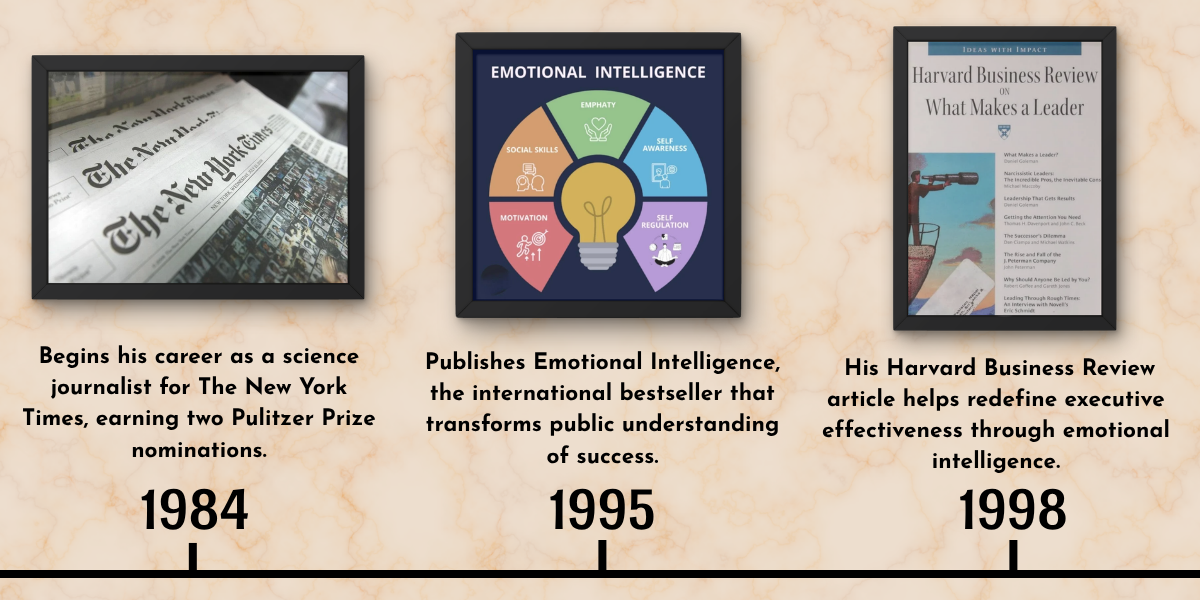
Daniel Goleman was born on March 7, 1946, in Stockton, California, to academically minded parents who both taught at local colleges. Raised in an environment that valued education, intellectual curiosity, and rigorous inquiry, he developed an early appreciation for learning that would later shape his interdisciplinary approach to psychology. Yet alongside his academic interests, Goleman has spoken openly about experiencing anxiety during his youth, an experience that contributed to his lifelong fascination with emotional awareness and psychological well-being.
Goleman began his undergraduate studies at Amherst College before briefly returning to California, where he attended the University of California, Berkeley during a challenging period in his life. While there, he encountered meditation and Eastern philosophy for the first time. At a time when contemplative traditions remained largely outside mainstream Western psychology, these experiences sparked an enduring interest in the relationship between consciousness, attention, and emotional development.
After graduating magna cum laude from Amherst in 1968, Goleman received a Ford Foundation fellowship to pursue graduate studies at Harvard University. There, he earned both his master’s degree and Ph.D. in psychology while undertaking an unusually deep study of Asian systems of psychology, meditation, and contemplative practice. Rather than viewing these traditions as purely religious or philosophical, Goleman approached them as sophisticated systems for understanding the mind—an interest that would remain central throughout his career.
His graduate research led him to travel extensively in India and Sri Lanka, where he studied with meditation teachers and practitioners representing a variety of contemplative traditions. These firsthand experiences convinced him that centuries of Buddhist and Hindu psychological inquiry offered valuable insights into attention, emotion, compassion, and mental training that deserved serious scientific investigation. Long before mindfulness became a subject of widespread academic research, Goleman recognized the potential for meaningful dialogue between Eastern contemplative traditions and Western psychology.
These experiences formed the foundation of his first major book, The Meditative Mind: The Varieties of Meditative Experience, published in 1977. One of the earliest comprehensive examinations of meditation written for a Western audience, the book synthesized contemplative traditions through the lens of contemporary psychology, helping introduce many readers to practices that would later become central to the fields of mindfulness and contemplative science.
Following his graduate work, Goleman briefly taught psychology and consciousness studies at Harvard before pursuing a career in science journalism. In the 1980s, he joined The New York Times as a science reporter, where he covered psychology, neuroscience, behavioral science, and medicine. The position proved pivotal to his development as a writer. Reporting on emerging scientific research required him to translate complex psychological concepts into clear, engaging language without sacrificing intellectual rigor, a skill that would later distinguish his bestselling books.
Goleman’s international reputation was established in 1995 with the publication of Emotional Intelligence. Drawing upon research from psychology, neuroscience, education, and child development, the book challenged the prevailing assumption that IQ alone determined success in life. Instead, Goleman argued that qualities such as self-awareness, emotional regulation, empathy, motivation, and social skill play equally important roles in personal fulfillment, effective leadership, and healthy relationships. The book became an international bestseller, remained on bestseller lists for well over a year, and transformed emotional intelligence from a relatively specialized psychological concept into one of the defining ideas of modern personal and professional development.
Over the following decades, Goleman continued expanding these themes through influential books including Working with Emotional Intelligence, Social Intelligence, and Focus, exploring how emotional and cognitive abilities shape learning, decision-making, leadership, and organizational performance. His work also played an important role in advancing social-emotional learning, helping educators recognize that emotional competencies are essential components of children’s academic achievement, psychological resilience, and long-term success.
Alongside his contributions to psychology, Goleman became one of the leading advocates for contemplative science. Through his longstanding involvement with the Mind & Life Institute and collaborations with the Dalai Lama, neuroscientist Richard Davidson, and other leading researchers, he helped foster dialogue between Buddhist contemplative traditions and modern neuroscience. These efforts contributed significantly to the growing scientific study of meditation, compassion, attention, and human flourishing, helping establish contemplative practice as a legitimate area of psychological and neuroscientific research.
Today, Daniel Goleman is recognized as one of the foremost interpreters of psychological science for the general public. By bringing together insights from psychology, neuroscience, education, leadership studies, and contemplative traditions, he has helped reshape how individuals and organizations understand intelligence, emotional development, and human potential. His work has influenced not only psychologists and researchers but also educators, business leaders, healthcare professionals, and millions of readers seeking a deeper understanding of the skills that enable people to thrive.
Three of Daniel Goleman’s Most Influential Works
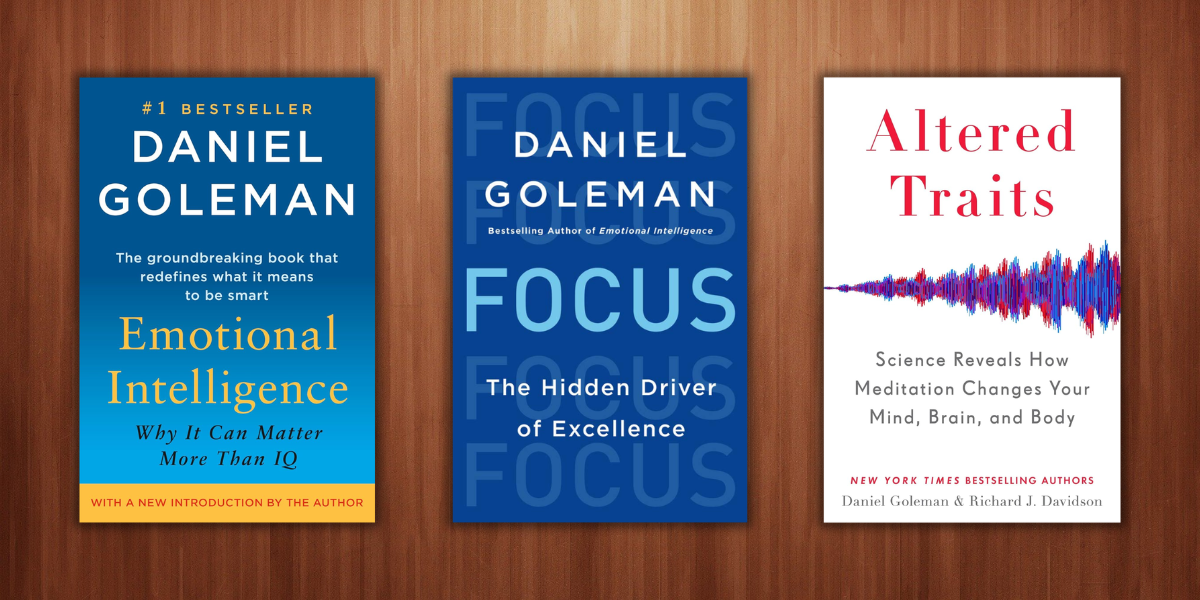
Long before concepts such as emotional intelligence and mindfulness entered everyday conversation, Daniel Goleman was helping bridge the gap between academic research and public understanding. Drawing upon findings from psychology, neuroscience, and contemplative science, he challenged conventional assumptions about intelligence, performance, and human potential. The following books showcase several of the ideas that have made him one of the most influential voices in contemporary psychology.
Emotional Intelligence (1995):
Published at a time when intelligence was still largely viewed through a traditional lens, Emotional Intelligence: Why It Can Matter More Than IQ offered a groundbreaking alternative perspective. Synthesizing research from psychology, neuroscience, and child development, Daniel Goleman argues that emotional competencies such as empathy, self-control, motivation, and social awareness are essential components of success and well-being. The book became an international bestseller and helped establish emotional intelligence as a major area of psychological inquiry. Goleman writes:
People with well-developed emotional skills are also more likely to be content and effective in their lives, mastering the habits of mind that foster their own productivity; people who cannot marshal some control over their emotional life fight inner battles that sabotage their ability for focused work and clear thought.
Focus (2013):
In an age increasingly defined by distraction, Daniel Goleman turned his attention to one of psychology’s most important yet often overlooked capacities: attention itself. In Focus: The Hidden Driver of Excellence, he draws upon cognitive science and neuroscience to examine how different forms of attention influence learning, performance, relationships, and decision-making. The book argues that the ability to direct and sustain attention may be one of the most important predictors of success in modern life. Goleman writes:
The antidote for mind wandering is meta-awareness, attention to attention itself, as in the ability to notice that you are not noticing what you should, and correcting your focus. Mindfulness makes this crucial attention muscle stronger.
Altered Traits (2017):
As meditation and mindfulness became increasingly popular in Western culture, Daniel Goleman and neuroscientist Richard Davidson sought to separate scientific evidence from exaggerated claims. In Altered Traits: Science Reveals How Meditation Changes Your Mind, Brain, and Body, they synthesize decades of research to examine how contemplative practice influences the brain, emotions, attention, and behavior over the long term. Their central conclusion is that the deepest benefits of meditation emerge not through temporary altered states but through lasting psychological traits developed through sustained practice. The authors write:
Our society suffers from an attention deficit. Today’s children grow up with a digital device at hand continuously, and those devices offer constant distractions (and a larger stream of information than for any generation in the past), so we consider boosting attention skills to be nothing short of an urgent public health need.
20 Thought-Provoking Daniel Goleman Quotes
In a very real sense we have two minds, one that thinks and one that feels.
Leadership is not domination, but the art of persuading people to work toward a common goal.
It’s not the chatter of people around us that is the most powerful distractor, but rather the chatter of our own minds. Utter concentration demands these inner voices be stilled.
There is perhaps no psychological skill more fundamental than resisting impulse.
Emotional Intelligence’ refers to the capacity for recognizing our own feelings and those of others, for motivating ourselves, and for managing emotions well in ourselves and in our relationships. It describes abilities distinct from, but complementary to, academic intelligence, the purely cognitive capacities measured by IQ.
You need the negative focus to survive, but a positive one to thrive.
If your emotional abilities aren’t in hand, if you don’t have self-awareness, if you are not able to manage your distressing emotions, if you can’t have empathy and have effective relationships, then no matter how smart you are, you are not going to get very far.
Emotional self-control—delaying gratification and stifling impulsiveness—underlies accomplishment of every sort.
People’s beliefs about their abilities have a profound effect on those abilities. Ability is not a fixed property; there is a huge variability in how you perform. People who have a sense of self-efficacy bounce back from failures; they approach things in terms of how to handle them rather than worrying about what can go wrong.
Our emotional mind will harness the rational mind to its purposes, for our feelings and reactions—rationalizations—justifying them in terms of the present moment, without realizing the influence of our emotional memory.
Daydreaming incubates creative discovery.
An altered trait—a new characteristic that arises from a meditation practice—endures apart from meditation itself.
Directing attention toward where it needs to go is a primal task of leadership.
In a complex world where almost everyone has access to the same information, new value arises from the original synthesis, from putting ideas together in novel ways, and from smart questions that open up untapped potential.
Emotional resilience comes down to how quickly we recover from upsets. People who are highly resilient—who bounce back right away—can have as much as thirty times more activation in the left prefrontal area than those who are less resilient.
Meditation is an attentional workout, and that’s definitely a pathway to letting optimal states occur more often.
Amid the din and distraction of work life, poor listening has become epidemic.
Lessening the grip of the self, always a major goal of meditation practitioners, has been oddly ignored by meditation researchers, who perhaps understandably focus instead on more popular benefits like relaxation and better health.
All meditation methods at their root are practices in strengthening attention.
The near cousin of optimism is hope: knowing g the steps needed to get to a goal and having the energy to pursue those steps. It is a primal motivating force, and its absence is paralyzing.
Affiliate Disclosure: Balanced Achievement earns a commission when books featured on our site are purchased through Amazon affiliate links. This comes at no additional cost to readers and helps support our work. All books are selected independently based on their quality, relevance, and editorial merit.

