


 Patrick Zeis
With bestselling titles from iconic voices and revolutionary ideas for self-transformation, 2025 offered countless pathways toward meaning and fulfillment. Over the past twelve months, we’ve explored more than four hundred new books charting the evolving frontiers of human growth—spanning psychology, spirituality, and self-help—and now, as December brings both reflection and renewal, we reexamine the year’s most compelling works across an ever-broadening range of categories. These new rankings spotlight the ideas continuing to shape the landscape of well-being, illuminating human flourishing through a seamless blend of timeless wisdom and modern insight.
What unites our selections for the 50 best psychology books released in 2025 is not a single theory, school of thought, or scientific discipline, but a shared commitment to understanding the complexities of human nature. Drawing from psychology, neuroscience, mind-body medicine, and behavioral science, these titles respond to the realities shaping modern life with evidence-based frameworks that aim to reduce suffering and support healthier, more adaptive ways of living. From emotional regulation and personality change to vagus nerve stimulation and the science of connection, they converge on a common goal: advancing a more integrated, humane, and actionable vision of psychological well-being.

50.) Jung’s Life and Work — C. G. Jung & Aniela Jaffé:
Marking the 150th anniversary of Carl Jung’s birth, Jung’s Life and Work: Interviews for Memories, Dreams, Reflections with Aniela Jaffé restores the legendary psychologist’s voice in all its candor and complexity. The book presents the original interviews that formed the basis of his iconic memoir, revealing Jung as both a visionary thinker and a humble seeker wrestling with the mysteries of psyche and spirit. Enriched by an editorial team led by Sonu Shamdasani, this collection is published in its entirety for the first time, standing as an intimate self-portrait of a man still uncovering meaning at the edge of existence and the eternal. Shamdasani offers some initial insights into the dialogue in the book’s introduction, writing:
While the published version of Memories, Dreams, Reflections was cast in the form of a chronological life narrative, the protocols of the original interviews show Jung ranging across an array of subjects in an associative manner in a single interview… Thus, the interviews present not only recollections of times past, but a critical chapter in Jung’s evolving self-understanding and the elaboration of his work—and critically, a window into his own personal cosmology.

49.) The Genius Myth — Helen Lewis:
In The Genius Myth: A Curious History of a Dangerous Idea, acclaimed journalist Helen Lewis dismantles the seductive notion of the singular genius and reveals how this flawed belief has shaped—and skewed—our understanding of creativity, innovation, and success. By examining how the label of genius has long been used to consolidate power, excuse misconduct, and uphold systems that reward privilege, Lewis makes a compelling case that the term reflects less genuine intellectual brilliance than the biases, exclusions, and conveniences society is willing to accept. With sharp wit and provocative insight, she illuminates the blind spots concealing our cultural delusion by spotlighting the collaborators, conditions, and social forces that are disregarded in genius narratives. Lewis writes:
Because there is no objective definition of genius — and there never can be — societies anoint exceptional people as geniuses to demonstrate what they value. We call some people ‘special’ to demonstrate what we find special. And in turn, we give those special people latitude that is not extended to ordinary mortals. We have a set of stories about what geniuses are, and how they work, and how singular their achievements are — stories that are often entirely untrue.

48.) Valley of Forgetting — Jennie Erin Smith:
In Valley of Forgetting: Alzheimer’s Families and the Search for a Cure, investigative journalist Jennie Erin Smith unearths a haunting true story from the Colombian highlands—where a rare genetic mutation has turned entire families into living case studies in the global quest to understand Alzheimer’s disease. With the precision of a researcher and the empathy of a storyteller, Smith chronicles not only the groundbreaking research led by Dr. Francisco Lopera, but also the everyday resilience of families who—while facing generational memory loss—have become central to one of the most important neurological studies of our time. Valley of Forgetting is a profound reminder that behind every medical breakthrough lies a story of trust, vulnerability, and the quiet heroism of those willing to share their lives in the name of progress. Smith sets the stage by writing:
In late 2017, I moved to Medellín to learn about the researchers who had discovered this famous cluster of early-onset Alzheimer’s disease, the families who lived with it, and the science that was emerging from their decades of close collaboration. By then Lopera had built a whole research institution, the Grupo de Neurociencias de Antioquia, around his work with this kindred. Their unique genetic mutation, dubbed the paisa mutation, had been found to be as old as the Spanish conquest of the Americas. Lopera made no bones about his ambition: after decades of work, he was hoping to discover, in this cohort of rural Colombians and their children and grandchildren, a treatment, maybe even a cure, for Alzheimer’s disease. The large extended family he studied counted some six thousand members, making it bigger on an order of magnitude than any other early-onset Alzheimer’s cluster known to exist.

47.) Anointed — Toby Stuart:
From the art world to corporate boardrooms, social status silently shapes who rises, who falls, and who gets remembered. In Anointed: The Extraordinary Effects of Social Status in a Winner-Take-Most World, organizational theorist Toby Stuart reveals how invisible hierarchies influence everything from our health and careers to our cultural tastes and daily interactions. Both a rigorous analysis and a compelling narrative, the book illuminates the hidden rules of power and offers insight into how awareness of status dynamics might inform a more equitable future. Stuart writes:
As you read the following chapters, I hope anointment will no longer seem like a veiled, mysterious force operating out of view. With a better understanding of our winner-takes-most world, I hope you’ll be able to engage more insightfully with some of today’s most pressing social questions. Most of all, I hope that a new understanding of anointment and its workings will enable more empathy both individually and collectively.

46.) The Mind Electric — Pria Anand:
Pria Anand’s The Mind Electric: A Neurologist on the Strangeness and Wonder of Our Brains offers a poetic and piercing exploration of the brain’s deepest mysteries—where the lines between self, story, and reality blur, and the peculiar is revealed as profoundly human. Through vivid narrative, Anand, a Boston University neurologist and professor, guides readers through tales of blindness born of guilt and songs that haunt the mind—illuminating how neurological disorders can fracture identity while also revealing the fragile beauty of what it means to be human. Weaving together research and lived experience, The Mind Electric honors the science of the brain while advocating for a more compassionate individualized treatment approach. Anand writes:
The chapters that follow explore not only neurologic illnesses and the fables they give rise to, but also the way that these illnesses are framed in hospitals and clinics when they afflict the bodies of people who have historically been marginalized by the culture of medicine: women, Black and brown people, displaced people, disempowered people… This book seeks to both honor and contend with these stories within stories—the ones we tell about our minds, and the ones our minds tell us—in all their wonder, strangeness, and heartbreak.

45.) Quieting The Storm — Ashley Booth:
Internal Family Systems (IFS) has become one of the most influential psychological frameworks of the past two decades, yet can feel opaque to those encountering it for the first time. By pairing clinical precision with artistic imagination, Ashley Booth’s Quieting the Storm Within: An Illustrated Introduction to Your Parts Through Internal Family Systems and Beyond distills core IFS principles into visual storytelling that makes the mind’s inner dynamics immediately graspable. Equally valuable as a psychoeducational resource for therapists and a self-guided introduction to parts work for individuals, the book invites readers to meet their inner system with curiosity, compassion, and a growing sense of self-leadership. Richard Schwartz, developer of the IFS model, offered praise for the book, writing:
I am so grateful to Ashley Booth for creating this delightful rendition of the model I have spent my adult life developing, Internal Family Systems (IFS). By combining her evocative and playful illustrations with a deep understanding of IFS, she has created a vehicle for anyone to quickly comprehend IFS and begin using it to access their Self and change their relationship with their parts. By handing this book to their clients, IFS therapists won’t have to spend sessions explaining the model and, once the book’s use is widespread, it will help many do IFS on their own.

44.) Breathwork and Psychotherapy — Jessica Dibb:
Breath is our most constant companion, yet few realize its vast potential for healing, integration, and transformation. In Breathwork and Psychotherapy: Clinical Applications for Healing and Transformation, Jessica Dibb, co-director of The Global Professional Breathwork Alliance, bridges ancient traditions, contemporary science, and clinical practice to show how conscious breathing can reshape physiology, regulate emotions, and deepen therapeutic work. Through clinical methods, case studies, and practical guidance, she offers both professionals and general readers a comprehensive roadmap to harnessing the breath as a profound tool for resilience, presence, and love. Dibb writes:
As we wend our way through the adventure in these pages, I dare hope we will experience unions of science and soul, methodology and creativity, maps and uncharted territory, boundaries and boundlessness, trauma and resiliency, body and spirit, heart and head, and self and other. I hope we will be inspired to reenvision a humanity that centers breathing. In the end, this is all about love. All our efforts are, at core, the desire to love… to be loved… to be love… and to be the creativity to which love gives birth. And breathing is not only what makes all this possible—it is a universal vehicle for its actualization and full flowering.

43.) Pull — Brennan Spiegel:
What if the secret to emotional balance, physical health, and even happiness lay in the very force that holds us to the Earth? In Pull: How Gravity Shapes Your Body, Steadies the Mind, and Guides Our Health, physician and researcher Brennan Spiegel reveals how gravity not only shapes our anatomy but also profoundly influences mood, digestion, and overall well-being. A leading voice in integrative medicine, Spiegel presents a transformative framework for cultivating balance and fortitude—anchored in the novel idea of gravity resilience. In the book’s introduction, he writes:
In this book, you will discover how gravity shapes not only our bodies but also our moods, health, and even our perception of the world. By the end of this journey, you’ll have a new perspective on time-tested interventions like weight loss, exercise, improved sleep, healthy eating, proper hydration, yoga, meditation, standing desks, balance boards, and music therapy. Far from being mere lifestyle choices, these practices share a more profound connection: They all enhance our resilience to gravity.

42.) Primal Intelligence — Angus Fletcher:
What if the mental edge that made Shakespeare, Curie, and Jobs extraordinary could be cultivated in all of us? In Primal Intelligence: You Are Smarter Than You Know, Ohio State professor Angus Fletcher presents a compelling neuroscientific framework that identifies intuition, imagination, and common sense as the foundations of human genius. Drawing on military training, classroom applications, and history’s most revolutionary achievements, Fletcher reveals how this hidden intelligence offers a uniquely human advantage in a world increasingly defined by AI. He writes:
As our ancestors self-reflected, using their intelligence to examine itself, they parsed it into four primal powers: intuition, imagination, emotion, and commonsense. Intuition perceives the world’s hidden rules. Imagination makes the future. Emotion knows the path of personal growth. Commonsense decides wisely in uncertainty… My theory is that intuition, commonsense, and the rest of Primal Intelligence are driven by narrative cognition. Or to put it in regular speak: The human brain is real-life smart because it thinks in story.

41.) Gaslit Brain — Jennifer Fraser:
In Gaslit Brain: Protect Your Brain from the Lies of Bullying, Gaslighting, and Institutional Complicity, neuroscientist and educator Jennifer Fraser exposes the neurological damage caused by manipulation, deception, and abuse. Drawing on cutting-edge brain imaging research, she shows how repeated dishonesty and psychological aggression can rewire neural pathways, distorting perception, trust, and identity. Blending science with advocacy, Fraser offers six evidence-based strategies to help readers reclaim clarity, autonomy, and resilience in the face of systemic manipulation. She writes in the introduction:
The Gaslit Brain unpacks individual and institutional self-serving lies. It looks at ways to identify lies, protect your brain from their harmful impact, and maintain your safety and sanity. The book examines the way certain individuals and institutions strive to make you believe something that is not true for personal gain, whether psychological, financial, or reputational.

40.) How We Grow Up — Matt Richtel:
What happens when an ancient, risk-seeking brain meets the hyper-stimulated landscape of modern adolescence? In How We Grow Up: Understanding Adolescence, Pulitzer Prize–winning journalist Matt Richtel combines cutting-edge neuroscience with deeply human storytelling to illuminate the biological, emotional, and social terrain of today’s teen years. As rates of teen anxiety and depression continue to rise, Richtel uncovers how a mismatch between biology and culture fuels today’s mental health crisis—and offers a compassionate roadmap for guiding the next generation into adulthood. He writes:
Young people today face steep new challenges and a world changing at lightning speed. But if we understand who they are, and how we got here, we can empower adolescents to harness this world and carry us all forward. There are some painful stories in this book and a lot of science, but, in the end, it is about solutions, and hope. That makes it sound like this book is for parents and policymakers, and that is true. But I’ve also written this for adolescents, and it is my ambition these pages will give you insights, powerful tools, and answers for growing up healthy and happy.

39.) You Already Know — Laura Huang:
With the authority of a top business school professor and the insight of a behavioral scientist, Laura Huang demystifies intuitive decision-making in You Already Know: The Science of Mastering Your Intuition. Drawing on hundreds of interviews, organizational psychology, behavioral economics, and her own groundbreaking research, Huang offers a research-backed framework for cultivating intuition as a repeatable, trustworthy tool for success. By bridging the gap between inner knowing and deliberate action, You Already Know transforms intuition from a quiet mystery into a practical method—one that empowers readers to move through life and leadership with clarity and confidence. Huang writes:
Our intuiting process constantly draws on physical, emotional, and cognitive inputs. Each piece may seem distinct, but they are intricately intertwined, creating a constant push-and-pull, a back-and-forth that shapes our choices. There isn’t necessarily a beginning, middle, and end. It’s a holistic integration of what we know, what we feel, and what our bodies sense, leading to decisions that are deeply informed by the full spectrum of our human experience, compelling us to action. This is the challenge of quantifying the unquantifiable. But we’re going to do so, because the payoff will be extraordinary. Are you ready?

38.) Shatterproof — Tasha Eurich:
In Shatterproof: How to Thrive in a World of Constant Chaos (And Why Resilience Alone Isn’t Enough), organizational psychologist Tasha Eurich introduces a bold new framework for navigating life’s inevitable challenges—empowering us to cultivate self-understanding and grow through adversity. At the heart of the book is the Shatterproof four-step process—probing our pain, tracing our triggers, spotting our shadows, and picking our pivots—designed to help readers shift from reactive survival strategies to proactive personal transformation in the face of daily stress and broader turmoil. By reframing our mindset and deepening our self-awareness, Shatterproof shows that we can do more than bounce back—we can bounce forward, stronger and more aligned than ever before. Eurich writes:
By following the four steps of the Shatterproof Road Map in the chapters ahead, you will learn to go beyond merely bouncing back from stress or setbacks and begin to confidently channel them into forward growth. Part empowering manifesto, part scientific exploration, and part how-to guide, I hope Shatterproof will provide you new clarity and language around a few experiences you may have struggled to explain or describe, while setting you on the path to feeling better, doing better, and living better than you ever have before.

37.) Rise Above —Scott Barry Kaufman:
Like a lighthouse cutting through fog, Rise Above: Overcome a Victim Mindset, Empower Yourself, and Realize Your Full Potential helps readers navigate the murky waters of self-pity and helplessness toward the solid ground of personal agency. Grounded in cutting-edge psychology and brimming with compassionate wisdom, Scott Barry Kaufman calls us to reclaim ownership of our stories and transform self-imposed limitations into opportunities for growth. For anyone ready to break free from old narratives and embrace the responsibility of authorship over their own lives, Rise Above is a compelling and empowering guide. Kaufman writes:
One of the most world-changing, groundbreaking shifts in consciousness you could possibly make right now is to realize just how much life really is what you make it. I’m not saying that’s easy. In fact, nothing in life that’s truly worth having is easy. But it’s possible, and it’s worth it. This book will use the latest tools of science to help you confront life with healthy vulnerability, bravery, wisdom, self-acceptance, life-acceptance, compassion, creativity, and healing. I assume these are things you want out of your life, and as you’re about to see, to a very large extent, you can have them.

36.) When Everyone Knows That Everyone Knows… — Steven Pinker:
Steven Pinker has built his career on revealing the hidden patterns of human behavior, and his latest work continues that tradition. In When Everyone Knows That Everyone Knows . . .: Common Knowledge and the Mysteries of Money, Power, and Everyday Life, he traces how a deceptively simple cognitive process explains the logic of diplomacy, social media mobs, romantic rituals, and market crashes. Brimming with humor, scholarship, and insight, this is Pinker at his most provocative and essential. He writes:
Originating in game theory and philosophy, the theory of common knowledge can illuminate a vast range of puzzles about human social life… My goal in this book is to explain the obscure but momentous research on common knowledge, together with some ideas of my own, and show how the concept illuminates many enigmas of our public affairs and personal lives.

35.) The Science of Revenge — James Kimmel Jr.:
From ancient feuds and religious crusades to modern mass violence and online outrage, our collective obsession with retaliation runs deeper than most of us realize—a truth Yale psychiatry lecturer and legal scholar James Kimmel Jr. confronts with clarity and compassion in The Science of Revenge: Understanding the World’s Deadliest Addiction—and How to Overcome It. Through a blend of neuroscience, psychology, historical anecdotes, and lived experience—including his own past struggles with quenching a thirst for retribution—Kimmel Jr. reveals revenge as an addictive biological brain process that manifests as both a personal affliction and societal contagion. In response, Kimmel offers evidence-based strategies for defusing inner rage and embracing forgiveness—not as moral high ground, but as a neurologically grounded pathway to healing and emotional liberation. Kimmel Jr writes:
We’ll focus in this book on how understanding revenge as an addictive process can help individuals and communities control the desire to hurt the people who hurt us and protect ourselves and those we love from harm. We’ll learn that there’s a courtroom inside every human mind where we try, convict, sentence, and punish the people who wrong us and where, at the conclusion of these trials, we choose whether to carry out the punishments in flesh and blood, in the here and now. We’ll learn how our addictive brain biology turns these trials into kangaroo courts, but also how we can regain control by adapting and expanding strategies that have been successful in preventing and treating other addictive behaviors.

34.) The Explorer’s Gene — Alex Hutchinson:
New York Times bestselling author and science journalist Alex Hutchinson investigates the timeless human impulse to venture into the unknown in The Explorer’s Gene: Why We Seek Big Challenges, New Flavors, and the Blank Spots on the Map. Blending riveting storytelling with cutting-edge scientific insights, Hutchinson explores why we’re drawn to explore, how we do it, and what exploration means in today’s world. Far from obsolete in our hyper-connected age, he argues that exploration—whether physical, emotional, or intellectual—remains essential to fulfillment and growth. At its core, The Explorer’s Gene dismantles the myth that exploration is dead, revealing how adventure and discovery remain hardwired into our DNA. Hutchinson writes:
I’ve come to believe that the drive to explore can be both a source of meaning in our lives and a spur for growth. What makes exploring hard—the uncertainty, the struggle, the possibility of failure—is, at least in part, what makes it rewarding. That doesn’t mean pushing onward to see what’s around the next corner or over the next ridge is always the right choice, though. Letting your exploring circuitry take the reins can also leave you starving in the jungle, stranded on an ice-jammed ship, or staring endlessly at the flickering screen of your phone. To harness the power of exploring, then, we need to understand why we’re drawn to the unknown, what we’re seeking there, and how we can do it better.

33.) The Grieving Body — Mary-Frances O’Connor:
For generations, we’ve treated grief as an emotional or spiritual wound, rarely acknowledging its physical dimension. In The Grieving Body: How the Stress of Loss Can Be an Opportunity for Healing, pioneering neuroscientist Mary-Frances O’Connor bridges that divide, revealing how loss reshapes the body as profoundly as it transforms the mind. Organized into two illuminating parts, the book, a follow up to O’Connor’s 2022 bestseller The Grieving Brain, first examines the physical nature of grief—tracing its effects on the heart, liver, lungs, brain, and the neuro-immuno-endocrine network—before turning to restorative pathways grounded in energy, motivation, awareness, love, social connection, and purposeful intention. She writes in the book’s introduction:
When a loved one dies, it is not just our brain that responds. Our reaction to loss is not only in our thoughts, our emotions, our mind. The response to the death of a loved one is a physiological one as well, reverberating through our body… Grieving, as I wrote about in my first book, The Grieving Brain, can be thought of as a form of learning. Grieving can also be an opportunity for healing. The opportunity arises if we can listen to the messages of stress in our body, those internal sensations and emotions. We can slowly begin to respond to them in a healthy and compassionate way, restoring a full life that takes our body’s needs into account.

32.) Who Deserves Your Love — KC Davis:
Bringing therapeutic insight to life with lighthearted illustrations and straightforward guidance, KC Davis’s Who Deserves Your Love: How to Create Boundaries to Start, Strengthen, or End Any Relationship is a refreshingly compassionate guide for anyone struggling to manage—or make sense of—their most complicated relationships. Rather than echoing the recycled mantras of modern self-help, the celebrated therapist and bestselling author of How to Keep House While Drowning offers grounded clarity on often-misunderstood ideas of relational responsibility, codependency, self-love, and the value of non-romantic bonds. In a world that too often treats boundaries as walls, Davis shows us how to use them instead as tools for creating more emotionally balanced, meaningful connections. She writes in the book’s introduction:
This book is a tool that will help you navigate the relationships you have and create the relationships you crave—whether romantic, platonic, or familial. It will guide you to figure out what you want, what you need, and what you can abide by, and how to communicate that to others… My goal is for you to identify the role that each person plays in the dynamics you encounter—to truly diagnose the issues at the heart of the matter—so that you can apply strategies that are appropriate, helpful, and healing.

31.) The Family Dynamic — Susan Dominus:
What happens inside a home that produces multiple high-achieving siblings on distinctive career paths? In The Family Dynamic: A Journey into the Mystery of Sibling Success, Pulitzer Prize–winning journalist Susan Dominus profiles six such families, exploring how shared upbringing can yield extraordinary yet divergent outcomes—from civil rights activists, musicians, and entrepreneurs to novelists, judges, and Olympians. What emerges is a nuanced portrait of sibling ambition, revealing that success within families is never formulaic but born of the delicate interplay of love, rivalry, circumstance, and chance. The Washington Post offered praise for this newly minted Amazon Editors’ pick for Best Books of the Year, writing:
The Family Dynamic will no doubt disappoint readers looking for bullet-pointed parenting-for-success tips. It’s just not that kind of book. It’s better. Dominus is smart, honest and wise, and at her best, very funny. Her findings offer a science-based reality check, while her fluid, artful writing can give parents a much-needed break.

30.) Flex Your Feelings — Emily Anhalt:
In Flex Your Feelings: Train Your Brain to Develop the 7 Traits of Emotional Fitness, clinical psychologist and Coa founder Emily Anhalt delivers a data-driven blueprint for developing seven traits of psychological well-being, skills she argues are as essential as any business or leadership strategy in today’s world. Framing emotional health as a set of capacities to be trained rather than a crisis to be managed, Anhalt offers practical exercises and real-world strategies for cultivating qualities such as mindfulness, curiosity, resilience, and empathy—one intentional flex at a time. In the book’s opening chapter, she writes:
Many people like to believe that if they’re not sick, they’re healthy. But talk to someone who prioritizes physical fitness—someone who sleeps eight hours a night, exercises, and eats well—and they’ll tell you, just because you aren’t ill, does not mean you’re physically fit. The same is true with emotional fitness—you might not be suffering from daily panic attacks, but that does not necessarily mean you are in good shape emotionally…. Transformation and personal growth demand consistent and directed effort. To develop as a human being and reach your full potential, you don’t need general principles. You need a regimen.

29.) Me, But Better — Olga Khazan:
Can you actually change your personality—or are you stuck with the same traits you’ve had since birth? In Me, But Better: The Science and Promise of Personality Change, award-winning Atlantic journalist Olga Khazan embarks on a personal and scientific quest to answer that exact question. With wit, charm, and humor, Khazan recounts what happened when she spent a year forcing herself to act like the healthiest, happiest, and most successful people do—a far cry from her usual penchant for “dwelling in dread.” Alongside the immersive joyride, Khazan supplies scientific insights and actionable strategies that show why becoming a better version of yourself might be more possible than you believe. Khazan writes:
Personality change can feel like an overwhelming proposition, and I was privileged to spend hundreds of hours on this project—in part because I was on book leave and didn’t have children. Almost no one can go all out like this, and they don’t have to. Some of the activities I describe are short: brief bouts of meditating, quick conversations with acquaintances, an afternoon spent throwing away unnecessary belongings. In the studies that I cite, most interventions take just a few minutes a day, yet they’re enough to create meaningful personality change. You don’t have to put your life on hold to change your personality; you can introduce small habits that add up to a big difference.

28.) How to Make Your Brain Your Best Friend — Rachel Barr:
In an era when mental health challenges touch nearly everyone, How to Make Your Brain Your Best Friend: A Neuroscientist’s Guide to a Healthier, Happier Life arrives as both a clear-eyed scientific guide to the mind and a compassionate invitation to relate to it differently. Neuroscientist Rachel Barr demystifies the brain’s complexity, showing how its constant flux and neuroplastic capacity can support healthier habits, emotional regulation, and lasting well-being, without resorting to optimization culture or self-control myths. Both rigorous and warmly human, the book reframes mental health not as a problem to be engineered away, but as a relationship to be understood and cared for. As Barr explains:
We’ve no reason to believe that self-optimization, ‘hacking your brain’ actually brings you any closer to feeling happy and fulfilled. Quite the reverse we see it happening all around us, people are struggling because in chasing this mirage, we’re missing out on what actually does make life meaningful, happy. Your brain is not machined to be hacked. It is a living breathing entity. The question then becomes not: ‘How can I hack my brain into submission?’ But ‘how do you make your brain your best friend?’

27.) Inner Sense — Caroline Williams:
What if your most powerful sense wasn’t sight or sound, but the subtle signals coming from within? In Inner Sense: How the New Science of Interoception Can Revolutionize Your Health, science journalist Caroline Williams explores the body’s “sixth sense”—our capacity to feel and interpret internal sensations like heartbeat, breath, and emotion. Blending neuroscience, mindfulness, and accessible storytelling, the book shows how tuning into this inner language can transform health, emotional balance, and self-understanding. After recounting her first experience of sensory deprivation in a flotation tank in the introduction, Williams writes:
What I didn’t know then was that in the process of tuning out from my surroundings, I would also be tuning in to a sense I didn’t know I had—an inner sense that is not only the centre of our personal universe but one of the most important concepts to emerge in science and medicine in decades. One that has the potential to bring better wellbeing, less stress, more energy, and new treatments for common, hard-to-treat conditions that affect mind, body or both.
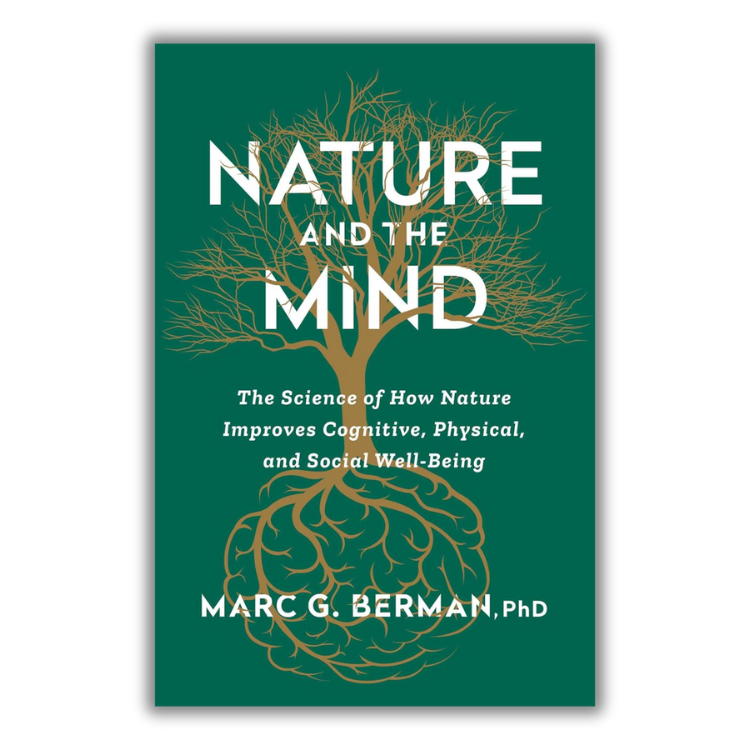
26.) Nature and the Mind — Marc Berman:
The outdoors are more than a backdrop to our lives—they are a profound force that shapes our psychological well-being, relationships, and communities. In Nature and the Mind: The Science of How Nature Improves Cognitive, Physical, and Social Well-Being, environmental neuroscience pioneer Marc Berman distills decades of research to show how time in the natural world—from leafy parks to rivers and coastlines—enhances attention, elevates mood, reduces disease, and fosters empathy. At its core, Nature and the Mind is both a landmark work in environmental neuroscience and an accessible guide for integrating nature’s healing power into modern life. Berman writes:
This is a book about why nature matters so much to us, and how our interactions with nature can tell us more about our own psychology—and even how our brains work… Environmental neuroscience has led me to grand visions of saving society with a worldwide nature revolution, but like every vast transformation, this one can start very small, with each of us: Just add a little green and experience the benefit in action.

25.) The Ageless Brain — Dale Bredesen:
In The Ageless Brain: How to Sharpen and Protect Your Mind for a Lifetime, renowned neuroscientist Dale Bredesen delivers a groundbreaking guide to lifelong cognitive vitality, blending the latest research with actionable prevention strategies. While Bredesen previously focused on reversing the effects of neurological disorders associated with cognitive decline in his instant New York Times bestseller The End of Alzheimer’s, his newest book shifts the spotlight toward optimal brain functioning and sustainable mental health. By exploring the essential components of cognitive vitality—such as performance, protection, purpose, diet, and renewal—The Ageless Brain redefines what’s possible for aging minds. Bredesen writes:
Starting right here and now, with just a few changes to the way you care for your brain, you can have sharper thoughts, crystal-clear memories, the ability to learn new information easily, and the capacity to take better control of your moods and emotions. What’s more, you can retain these powers for one hundred years of life or even longer. That might seem like an awfully big claim. And you know what? It is! What you will read in this book, after all, is not yet part of mainstream medicine.

24.) Why Do I Keep Doing This? — Kati Morton:
In Why Do I Keep Doing This?: Unlearn the Habits Keeping You Stuck and Unhappy, licensed therapist and mental health educator Kati Morton examines the habitual patterns that quietly shape our relationships, choices, and sense of self. With clinical clarity and personal candor, she shows how behaviors rooted in control, people-pleasing, and emotional suppression often begin as survival strategies—and then harden into habits that limit growth. The result is a compassionate guide to recognizing what once kept us safe—and learning how to loosen its grip. In the book’s introduction, Morton writes:
So many of us push ourselves to the brink, believing that if we just manage things better, try harder, and never let anything slip, we’ll finally feel okay. But the truth is, control isn’t saving us, it’s breaking us. That’s what we’re going to unpack in these pages. Why we keep doing this to ourselves, where it comes from, and, most importantly, how to finally let go in a way that doesn’t feel like free-falling. Because there is another way, a way that allows us to feel safe, supported, and whole without needing to control every single detail of our lives.

23.) A Trick of the Mind — Daniel Yon:
Why do we sometimes see patterns that aren’t there, fall for conspiracy theories, or misjudge the intentions of others? In A Trick of the Mind: How the Brain Invents Your Reality, cognitive neuroscience professor and experimental psychologist Daniel Yon explains how the mind’s reliance on internal models—its best guesses about reality—can function as both a superpower and a trap. Accessible, provocative, and deeply relevant, the book illuminates the hidden forces shaping our perceptions, beliefs, and behavior, challenging readers to question the very foundation of their lived experience. Yon writes:
The idea that your brain is a scientist is transforming the way that neuroscientists think. And this idea can transform how you think too. Meeting the scientist inside your skull will start to make you think like a scientist. You’ll begin to see your mind and brain from the outside in. From this new vantage point, things seem rather different. Some of the seemingly simplest things your mind achieves turn out to be the strangest. And at the same time, experiences and beliefs that seem odd to begin with can start to make sense when you realize your mind is your brain’s best theory that you just happen to live inside.

22.) Why Brains Need Friends — Ben Rein:
Award-winning neuroscientist Ben Rein brings both expertise and empathy to Why Brains Need Friends: The Neuroscience of Social Connection, a revelatory exploration of how relationships shape the brain. Drawing on years of research and real-world insights, Rein reveals the hidden biology behind empathy, conversation, and community. The result is a beautifully written guide that reframes social connection as not merely an emotional luxury, but a neurological necessity. In the book’s introduction, he writes:
The human brain has been shaped through evolution to reward us for connection and punish us for isolation. As a result, we have so much to gain from socializing, and arguably even more to lose without it. We all know that we should really answer the phone more and make time for friends and family, but we’re seemingly not motivated enough to do something about it… When we fail to prioritize connection, our biology can struggle in ways most people don’t realize. I believe that if we truly appreciate what’s at risk, we may be more motivated to act.

21.) What We Value — Emily Falk:
Why do some choices feel aligned with who we are while others leave us feeling subtly off course? In What We Value: The Neuroscience of Choice and Change, neuroscientist Emily Falk examines how values, identity, and motivation are encoded in the brain—revealing why behavior change succeeds or stalls over time. Blending social neuroscience with real-world application, the book offers a research-driven framework for aligning daily decisions, habits, and long-term goals with what genuinely matters. Falk writes:
So how do we expand our possibilities for choosing? This book explores some key brain systems that shape both what we choose and why we choose. Once we understand why we do what we do, we can explore how we might more deliberately align our daily decisions with our bigger-picture goals and values… I hope that if you understand how your brain makes decisions, you might see more possibilities in how to create value for yourself and others. If you’re feeling the constriction of cave walls, maybe it will help you to shine a light in a different direction, illuminating the levers that reveal new pathways, the pulley that opens a skylight.

20.) Releasing Our Burdens — Richard Schwartz & Thomas Hübl:
At a time when trauma has become both a personal epidemic and a communal inheritance, Releasing Our Burdens: A Guide to Healing Individual, Ancestral, and Collective Trauma offers a holistic path toward renewal. Integrating the psychological framework of Internal Family Systems with somatic theory and a transcendental approach to relational healing, Richard Schwartz and Thomas Hübl create a luminous map for navigating the terrain of suffering. Expansive in scope yet tender in tone, Releasing Our Burdens invites readers into a profound journey of restoration that begins with self-compassion and curiosity before rippling outward into a more attuned interconnection with the world. The authors write in the book’s introduction:
This book is a diversified journey through the various dimensions of trauma and healing—individual, ancestral, collective, and spiritual. Throughout this process, we’ll offer different approaches to healing and integration, namely personal reflections; meditations and related practices; and transcriptions of sessions with clients and course participants that unpack what our work looks like in real time (and hint at what it might look like for you, as well).

19.) Dealing with Feeling — Marc Brackett:
What if the single most important determinant of your success wasn’t intelligence, talent, or luck, but how you respond to your emotions? In Dealing with Feeling: Use Your Emotions to Create the Life You Want, Yale professor and emotional intelligence pioneer Marc Brackett shows that emotion regulation is not a fixed trait but a set of skills that can be learned, practiced, and refined. Blending scientific insight, practical strategies, and personal reflection, Brackett equips readers with tools to harness their feelings as guides toward stronger relationships, greater well-being, and meaningful personal accomplishment. In the book’s introduction, he writes:
There’s no magic involved in dealing with feelings. No one was born knowing how to regulate their emotions. If you can’t do it successfully, it’s likely because no one ever showed you how. Everything this book teaches is a practical skill, like so much of what you’ve learned. With practice, we can all deal with our feelings as we’ve always wished we could.

18.) The Gift of Not Belonging — Rami Kaminski:
With insight, empathy, and bold clarity, Rami Kaminski’s The Gift of Not Belonging: How Outsiders Thrive in a World of Joiners illuminates life through the lens of the otrovert—someone who, despite being socially capable and often well-liked, feels uneasy and alone in large group settings. Rather than pathologizing this outsider experience, Kaminski reframes it as a source of strength, arguing that emotional fulfillment, creativity, and self-worth often flourish outside the bounds of group identity. In doing so, The Gift of Not Belonging becomes a compelling call for otroverts to embrace their unique capacity for individuality, independent thinking, and resistance to societal pressures to conform. Kaminski writes:
If you fit in, others will let you be. This is why many otroverts spend their time trying to belong. Yet, for them, attempts to conform, be an insider, and experience togetherness is futile. They are not communal people and therefore cannot truly feel like a member of a group even if invited and encouraged. Nor do they want to. And therein lies one of the greatest benefits of being an otrovert: once you accept and understand who you are, you become free from the tremendous social pressures that group membership imposes.

17.) Life in Three Dimensions — Shigehiro Oishi:
Ever feel like the monotony of daily life leaves you craving something more? In Life in Three Dimensions: How Curiosity, Exploration, and Experience Make a Fuller, Better Life, renowned University of Chicago psychology professor Shigehiro Oishi argues that the fullest life isn’t found in happiness or meaning alone—it emerges when these are integrated with a third essential element. Oishi introduces psychological richness as this missing component—an orientation toward curiosity, new experiences, and stepping into uncertainty that broadens our perspectives and deepens our emotional lives. By weaving together research, real-world examples, and actionable insights, Life in Three Dimensions offers a compelling case for embracing all three dimensions of well-being to cultivate a truly fulfilling life. Oishi writes:
A psychologically rich life is a life filled with diverse, unusual, interesting experiences that change your perspective; a life with twists and turns; a dramatic, eventful life instead of a simple and straightforward one; a life with multiplicity and complexity; a life with lots of stops, detours, and turning points; a life that feels like a long, winding hike rather than many laps of the same racing circuit.
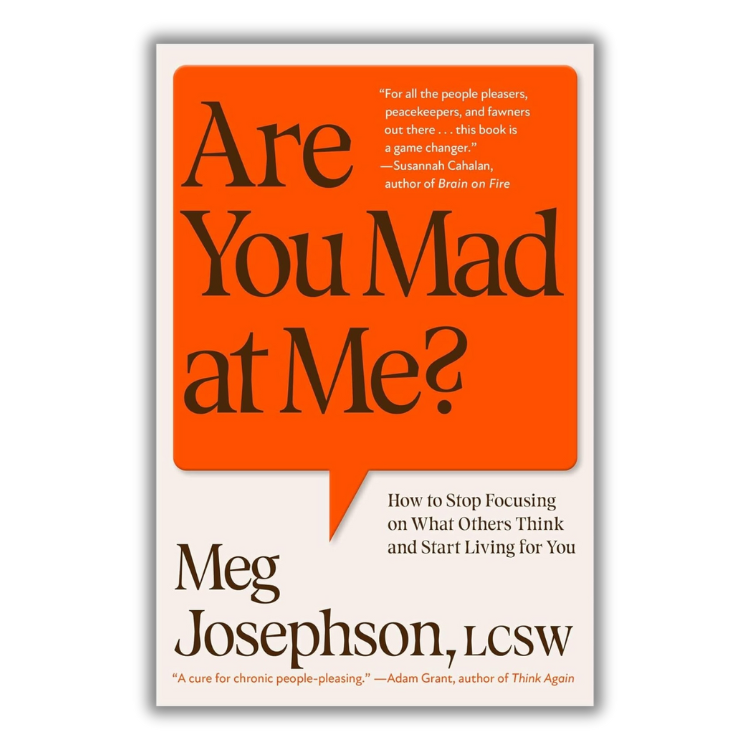
16.) Are You Mad at Me? — Meg Josephson:
In a world where anxiety and self-doubt play on repeat in the minds of many, Are You Mad at Me?: How to Stop Focusing on What Others Think and Start Living for You offers both psychological insight and practical tools for breaking free from the cycle. With clarity and warmth, psychotherapist Meg Josephson reframes people-pleasing as an outdated behavioral pattern—known as the “fawn response”—revealing how early coping strategies can harden into approval-seeking habits that quietly erode authenticity and joy. Combining clinical expertise with heartfelt storytelling and actionable exercises, this instant New York Times bestseller empowers readers to recognize these patterns and replace them with healthier ways of relating that cultivate both self-respect and deeper connection. Josephson writes:
Are You Mad at Me? is about holding ourselves with the degree of compassion that we’ve always wanted but thought we didn’t deserve. It’s about shedding the protective mechanisms that are keeping us stuck in the past and away from the present. It’s about releasing the belief that we need to neglect ourselves for the comfort of other people. It’s about removing the conditioning and the blockages that have disconnected us from the true essence of who we are and what we want in life. It’s about cultivating a sense of internal safety so that when everything else seems to be chaotic and out of our control, we have a quiet place to come back to.

15.) High Functioning — Judith Joseph:
In a culture that equates health and wellness with relentless productivity and success, psychiatrist Judith Joseph exposes the hidden emotional toll of incessant striving in High Functioning: Overcome Your Hidden Depression and Reclaim Your Joy. Drawing from clinical research, case studies, and her own lived experience, Joseph guides readers through the Five V’s—Validation, Venting, Values, Vitals, and Vision—a practical framework for recognizing and healing forms of depression that often go unseen. In a world that too often rewards burnout and emotional avoidance, this essential guide offers a path to renewal that begins with self-awareness and ends in self-compassion. Joseph writes:
This book sounds the alarm that the millions of us suffering from High-Functioning Depression are all forgetting something absolutely essential: how to enjoy life. We are walking around on autopilot without wondering where our path is taking us… People with High-Functioning Depression think of success as the only path to happiness. Healing can help a person realize they’re worthy of joy in life just as they are. Overcoming High-Functioning Depression can help you realize that in focusing on work and achievement, you’ve built the wrong life for yourself. Doing the work gives you a chance to uncover a new identity and create a new life for a new you.

14.) Fawning — Ingrid Clayton:
Most people recognize the trauma responses of fight, flight, and freeze—but few are even aware of the fourth: fawning. In Fawning: Why the Need to Please Makes Us Lose Ourselves—and How to Find Our Way Back, Ingrid Clayton draws on twenty years of clinical practice and her lived experience as a recovering fawner to show how chronic people-pleasing begins as a survival strategy and hardens into a pattern of self-abandonment. Both a groundbreaking exploration and a healing roadmap, the book offers a transformative guide to breaking free from compulsive appeasement and reclaiming one’s authentic voice. Clayton writes:
Fawners mirror or merge with someone else’s desires or expectations, to defuse conflict rather than confront it directly. Because it’s their best chance to stay safe. At least for now… Fawning is a common coping mechanism for those dealing with continuing relational trauma. Relational trauma is different from a single traumatic occurrence, such as a car crash or an assault. It’s a form of complex trauma, which is a relatively new term in the field of psychology. Complex trauma refers to ongoing pervasive threats to our safety, often interpersonal in nature.

13.) The Brain at Rest — Joseph Jebelli:
Accomplished neuroscientist and author Joseph Jebelli invites readers to rethink their hustle-driven habits in The Brain at Rest: How the Art and Science of Doing Nothing Can Improve Your Life. Blending accessible science, personal narrative, and practical guidance, Jebelli makes a persuasive case that deliberately setting aside time for mental rest and mind-wandering can enhance emotional well-being, spark creativity, and even improve productivity. By illuminating the benefits of regular non-striving—allowing the mind’s default mode network to operate freely—the book reveals why doing less is often a forgotten key to thriving. Jebelli writes:
In this book I want to show you how doing nothing has profound benefits for your brain, and that when you disengage from a task your brain activates a network vital for your mental and physical health. We call this network the default mode network: a circuit of neurons (brain cells that communicate through electrical and chemical signals) that enables us to daydream, mind wander, think reflectively and imagine the future… Crucially, the default mode network is only active when we are not focused on an exerting task; when the brain is cycling through thoughts not associated with our immediate environment; when, in short, our minds simply roam free.

12.) The Biology of Trauma — Aimie Apigian:
Drawing from her dual expertise in medicine and trauma therapies, Dr. Aimie Apigian delivers a grounded and illuminating vision of healing in The Biology of Trauma: How the Body Holds Fear, Pain, and Overwhelm, and How to Heal It. Weaving clinical research with real-life stories, Apigian shows how unresolved emotional wounds manifest in the body—and how targeted strategies can gently rewire those patterns. The result is a compassionate and empowering guide that places the biology of safety at the heart of recovery. Organizational psychologist Benjamin Hardy offered praise for the book, saying:
This isn’t just another book about trauma; it’s a scientifically grounded road map for reclaiming your future by healing your biology. For anyone serious about sustainable personal transformation, this work provides the missing piece between intention and lasting change.

11.) The DOSE Effect — Tj Power:
Feeling stuck in stress, burnout, or emotional exhaustion? Your brain chemistry may be to blame—but it’s also the solution. In The DOSE Effect: Optimize Your Brain and Body By Boosting Your Dopamine, Oxytocin, Serotonin, and Endorphins (DOSE), neuroscientist Tj Power demystifies the four neurotransmitters that govern our happiness and shows how simple, science-backed strategies can help us take control of our psychological well-being. Rather than chasing fleeting highs, Power introduces sustainable methods to recalibrate our brain’s reward system, boost social connection, and cultivate inner peace. Packed with practical tools, cutting-edge research, and real-world applications, this book is a practical manual for elevating your mood, energy, and focus. Power writes:
DOSE is an acronym for the four key chemicals that live within your brain and body. These are Dopamine, Oxytocin, Serotonin, and Endorphins. These chemicals have evolved within us throughout our 300,000 years of human development. These chemicals are our friends. They are here to guide us towards the best experience of life we can possibly have. Our goal throughout The DOSE Effect is simply to learn how to listen to them. Once you understand how they impact your feelings, you will then learn to be guided by them.

10.) Validation — Caroline Fleck:
In a culture increasingly shaped by polarized debates and social media echo chambers, Validation: How the Skill Set That Revolutionized Psychology Will Transform Your Relationships, Increase Your Influence, and Change Your Life offers a vital communication tool rooted in understanding rather than division. Acclaimed psychologist and corporate consultant Caroline Fleck distills one of psychotherapy’s most powerful yet often overlooked principles: the ability to truly see and accept another’s perspective—without necessarily agreeing—can mend even the deepest rifts. Through an exploration of the what, why, how, and where of validation, Fleck demonstrates how empathy can serve as a transformative force in relationships, workplaces, and society at large. Blending engaging stories, insightful research, and practical strategies, Validation provides a compelling framework for fostering connection and influence in an increasingly fractured world. Fleck writes:
As a buzzword, validation has undoubtedly been trending. At some point, we all seem to have absorbed the message that it’s good for relationships. There just isn’t a ton of information on what it means, much less how to practice it. The validation skills that have proven to help people communicate acceptance are not common knowledge. As for the discovery that validation is an agent for change, that, too, is a secret to most. Alas, although many acceptance strategies have entered the cultural zeitgeist, DBT’s (Dialectical Behavior Therapy) groundbreaking validation skills remain outside of it.

9.) The Inherited Mind — James Longman:
Few memoirs balance emotional vulnerability and scientific rigor with the grace of The Inherited Mind: A Story of Family, Hope, and the Genetics of Mental Illness. Award-winning ABC News correspondent James Longman weaves the loss of his father to suicide, alongside his own struggles with depression, into conversations with leading scientific and psychological experts, illuminating how mental health, genetics, and environment intertwine across generations. The result is a compassionate meditation on inheritance—not as destiny, but as an opening toward understanding, agency, and hope. Longman writes in the book’s introduction:
My hope is that you’ll come away with an appreciation of how mental health patterns work in families, and what the very latest science is telling us about them. You’re going to hear from specialists and experts, but also regular people who’ve perhaps had experiences similar to your own. Researching the exciting new world of mental health genetics has really helped me feel better about my life. Put simply, I don’t feel so alone anymore, and I hope reading this book will do the same for you.

8.) The Great Nerve — Kevin Tracey:
In The Great Nerve: The New Science of the Vagus Nerve and How to Harness Its Healing Reflexes, renowned neurosurgeon and researcher Kevin Tracey unveils a new frontier in medicine, revealing how vagus nerve stimulation offers unprecedented promise for treating a wide range of chronic illnesses. Through vivid case studies, clear explanations, and compelling patient stories, Tracey demonstrates how activating the vagus nerve’s innate regulatory power could transform the treatment of inflammation-related conditions—from autoimmune and metabolic disorders to mental illness and neurodegenerative decline. While painting an inspiring vision of the future of healthcare, The Great Nerve also equips readers with science-backed lifestyle practices—such as cold exposure, breathwork, meditation, and exercise—that enhance vagal tone and support lasting mind-body wellness. Tracey writes:
As science and innovation converge on the vagus nerve in medicine and everyday life, we are coming to understand not only how to maintain it but also why our health and well-being depend on it… Learning about the great nerve inches us closer to a world in which catastrophic inflammation can be averted and inflammatory diseases that affect millions are better treated.

7.) The Age of Diagnosis — Suzanne O’Sullivan:
At a time when diagnostic language increasingly shapes how we understand ourselves, The Age of Diagnosis: How Our Obsession with Medical Labels Is Making Us Sicker aasks a difficult but necessary question: does naming a condition always lead to healing? Drawing on decades of clinical neurology practice, Suzanne O’Sullivan explores how labels meant to clarify suffering can sometimes entrench it—reshaping identity, heightening vigilance, and subtly altering how people experience their bodies. With empathy and restraint, she calls for new vocabularies of care that support meaning, resilience, and dignity beyond the confines of diagnosis. O’Sullivan writes in the book’s introduction:
In writing this book, I explore how modern medicine is redrawing the boundaries between sickness and health and what impact it is having on our lives. I have grown very concerned that we are turning increasing numbers of healthy people into patients with insufficient gain and unmeasured harms. Diagnosis is seen as the key that opens the door to so much that we long for—an explanation, the potential for recovery, support, a tribe of fellow sufferers—but there are darker things behind that door too that are not always given proper consideration.

6.) Beyond Anxiety — Martha Beck:
Globally acclaimed life coach and Harvard-trained sociologist Martha Beck flips the script on how we understand and experience anxiety in Beyond Anxiety: Curiosity, Creativity, and Finding Your Life’s Purpose. Instead of viewing it as a paralyzing roadblock that brings life to a standstill, Beck reveals how it can serve as a doorway to greater abundance, joy, and possibility. Drawing on insights from neuroscience, psychology, and Eastern spiritual traditions, Beck introduces the creativity spiral, a process that shifts the mind away from fear-based thinking by cultivating curiosity, ingenuity, and wonder. Rather than moving through life shackled by fear and worry, readers discover a new path illuminated by limitless potential. Beck writes:
This way of living beyond anxiety is radically liberating. It sets us free in more ways than we can count: Free to sustain an ongoing inner state of peace and self-compassion. Free to interact with others with confidence and wisdom rather than insecurity and tension. Free to engage with the pressures of society as powerful navigators and pathbuilders rather than as hapless wanderers. Free to create our own futures and approach them not as random avalanches of frightening events but as unfolding beneficent miracles. The capacity for all this freedom is your birthright; it’s been in you since the day you were born. As you leave anxiety behind, you’ll see that for yourself.

5.) How to Change a Memory — Steve Ramirez:
At the boundary of imagination and neuroscience lies a discovery that challenges everything we know about remembering. In How to Change a Memory: One Neuroscientist’s Quest to Alter the Past, Steve Ramirez traces his groundbreaking experiments on memory manipulation—from implanting false recollections in mice to envisioning therapies for PTSD and dementia. With clarity and compassion, he shows how reshaping memory may become one of the brain’s most profound tools for healing. Ramirez writes in the book’s introduction:
My quest to manipulate a memory is as scientific as it is personal. In each chapter I fold in some of the most valuable memories I’ve made in my life, both in and out of the lab. These personal stories are meant to showcase how the scientific process works from the perspective of the people who did the discovering. There’s a very human element at play in every discovery, which is sometimes overlooked or not told at all.

4.) Open When — Julie Smith:
In Open When: A Companion for Life’s Twists & Turns, clinical psychologist and bestselling author Julie Smith extends a steadying hand through life’s most turbulent moments. Presented across 26 chapters addressing universal challenges of emotional wellness and mental health—spanning three broad categories: being with others, being with ourselves, and being with our feelings—Smith offers transformative guidance through empathetic “Open When…” letters and evidence-based strategies for moving forward. With life’s ever-changing emotional tides, Open When serves as both a companion and a compass, helping readers navigate the vast sea of feeling with grace and self-understanding. Smith writes in the book’s introduction:
In moments of pain or confusion, most of us struggle to be the voice that we need to hear, not because we are pathological in some way, but because we are all simply learning as we go… This book can serve only as a lighthouse. Unable to pull you from the water, but able to shine a light in this direction so that you can work out which way is up when confusion reigns. Use that as you will, but the work of navigating toward calmer waters is all yours.

3.) Defy — Sunita Sah:
From corporate boardrooms to personal relationships, social pressure often demands subordination—but what if dissent and noncompliance are the keys to a better life? In Defy: The Power of No in a World That Demands Yes, award-winning professor and organizational psychologist Sunita Sah reframes defiance not as rebellion but as a necessary act of personal empowerment. Through fascinating real-world examples and groundbreaking research, Sah illustrates how the power of a ‘True No’ can challenge corruption, end cycles of manipulation, and bring about social change. For anyone tired of deferring to others and chronic people-pleasing, Defy may be the needed antidote that pushes you to speak up and act when it matters most. Sah writes:
Defiance doesn’t mean living your life in a constant state of acrimonious rebellion. Nor does it require grand actions. It does not even require confrontation. You don’t have to be Mahatma Gandhi or Cesar Chavez, Marsha P. Johnson or Malala Yousafzai. You don’t have to be active in a political cause. And you certainly don’t always have to defy. You just have to dare. Dare to imagine a life lived in accordance with your actual values. Dare to reclaim your agency. Dare to make decisions that align with your innermost principles, no matter the external pressures.

2.) Shift — Ethan Kross:
Ever found yourself trapped in a cycle of anxiety or frustration, unsure how to break free? In Shift: Managing Your Emotions—So They Don’t Manage You, psychologist and bestselling author Ethan Kross provides a science-backed roadmap for mastering your inner world. Drawing on groundbreaking research and real-world case studies, Kross reveals how subtle shifts in self-talk can profoundly reshape emotional responses, enhance decision-making, and improve relationships. Whether navigating high-stress situations at work or diffusing conflict at home, Shift—hailed as a must-read by both Oprah Winfrey and Adam Grant—offers clear, actionable guidance for gaining control over emotions—rather than letting them take control. Kross writes:
Our emotions, both the positive and the negative ones, are tools we use to navigate the world. They influence who we fall in love with and who we hate. They motivate us to stay longer hours at work to realize our dreams and rein in our aspirations when they no longer serve us. They can fill our lives with health and vitality or sap our energy when we lose sight of what matters… And yet, for all their profound impact on our lives, few of us receive a science-based guide for how to turn the volume on our emotions up or down, or how to transition gracefully from one emotional state into another.

1.) Mind Your Body — Nicole Sachs:
For decades, the medical field has treated chronic pain as a purely physical condition, yet millions remain trapped in cycles of suffering that defy diagnosis. In Mind Your Body: A Revolutionary Program to Release Chronic Pain and Anxiety, psychotherapist Nicole Sachs invites readers to consider a radical possibility: that the root cause of their pain may not be physical at all, but the body’s way of expressing unresolved emotional wounds and trauma. By illuminating the profound connection between body and mind, Sachs reveals that true relief from chronic pain—and from seemingly unrelated conditions such as anxiety, panic, and fatigue—emerges not through resistance, but through the courageous work of emotional processing and nervous system regulation. In the author’s note, Sachs writes:
Most chronic conditions originate from a dysregulated nervous system. It confusedly informs the brain to send signals of pain, inflammation, muscle constriction and spasm, neuralgia, and other physical and experiential manifestations to ‘protect and distract’ you from your overflowing repressed emotional reservoir. We, often unconsciously and for years, have lived in long-term, sustained fight or flight. Our health is failing as a result…. This book is an operating manual to change your life.
Balanced Achievement’s Best Books of 2025
The best books of the year do more than inform—they reshape how we see, think, and live. Below, you’ll find links to all our favorite titles released in 2025—spanning the genres of spirituality, psychology, and self-help—selected for their depth, originality, and capacity to offer lasting insight beyond the moment:
- The 50 Best Self-Help Books Released in 2025
- The 50 Best Psychology Books Released in 2025
- The 50 Best Spirituality Books Released in 2025
- The 25 Best Buddhism Books Released in 2025
- The 25 Best Mindfulness and Meditation Guidebooks Released in 2025
- The 10 Best Biographies and Memoirs Released in 2025
- The 10 Best Motivation and Mindset Books Released in 2025
- The 10 Best Physical Health and Longevity Books Released in 2025
- The 10 Best Fitness, Nutrition, and Weight Loss Books Released in 2025
- The 10 Best Relationships, Love and Intimacy Books Released in 2025
- The 10 Best Parenting Books Released in 2025
- The 10 Best Community, Connection, and Belonging Books Released in 2025
- The 10 Best Communication Skills Books Released in 2025
- The 10 Best Money and Personal Finance Books Released in 2025
- The 10 Best Career and Entrepreneurship Books Released in 2025
- The 10 Best Workplace Culture and Leadership Books Released in 2025
- The 10 Best Brain Fitness and Mental Health Books Released in 2025
- The 10 Best Emotional Wellness, Anxiety and Depression Books Released in 2025
- The 10 Best Grief and Trauma Recovery Books Released in 2025
- The 10 Best Hinduism Books Released in 2025
- The 10 Best Spiritual Ecology and Nature Books Released in 2025
- The 10 Best Non-Duality and Consciousness Books Released in 2025
- The 10 Best Psychedelics Books Released in 2025
Affiliate Link Disclosure: Balanced Achievement earns a commission when any of the books featured on our site are purchased directly through Amazon product links.

