

 Patrick Zeis
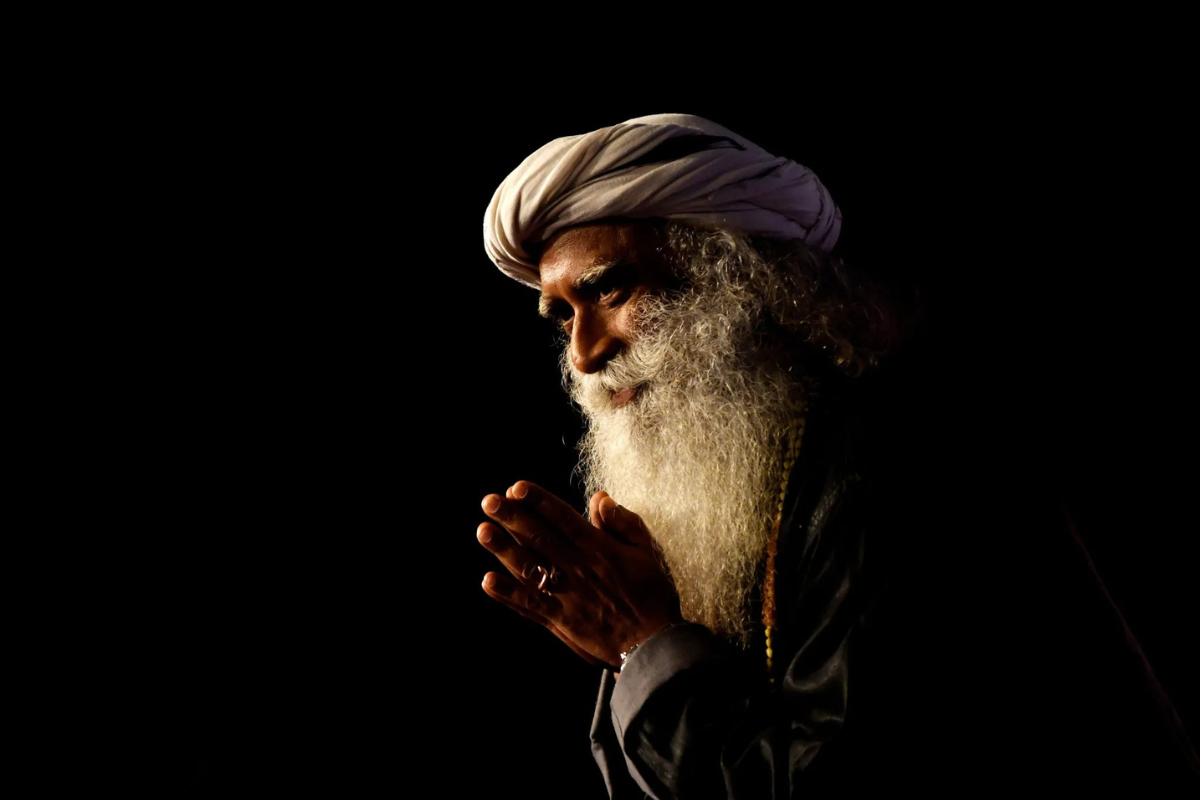
Snake handler, poultry farmer, motorcyclist, and avid outdoorsman are just a few of the roles that have shaped the unconventional life of Jaggi Vasudev, better known to millions as Sadhguru. As the founder of the Isha Foundation, he has become one of the world’s most recognizable contemporary spiritual teachers, combining traditional Hindu yogic wisdom with a practical and accessible approach that resonates with modern audiences. Through bestselling books, international speaking engagements, large-scale humanitarian initiatives, and a social media following exceeding 25 million people, Sadhguru has introduced countless individuals to the transformative potential of yoga, meditation, and inner growth.
The Life of Sadhguru
Jaggi Vasudev was born in 1957 in Mysore, a historic city in southern India long associated with learning, culture, and spiritual inquiry. Raised in a Telugu-speaking family, his father worked as an ophthalmologist with the Indian Railways, a profession that required frequent travel. This itinerant childhood immersed Vasudev early in the forests, rivers, and rural landscapes of southern India—an intimacy with the natural world that would later shape both his temperament and his spiritual language.
Unlike many revered Indian saints who displayed precocious religious devotion, Vasudev showed little early interest in scripture or theology. His formative years were marked instead by athleticism, exploration, and an independent spirit. As a boy he spent long hours in the wilderness surrounding Mysore, developing a love for adventure that would later express itself through motorcycling, trekking, and solo travel.
At the age of twelve, he was introduced to basic yogic asanas by Malladihalli Raghavendra, a well-known yoga teacher of the time. Though the instruction was limited, Vasudev maintained a daily yoga practice throughout adolescence—without pursuing formal spiritual study or affiliating with a lineage. Yoga, for him, remained experiential rather than doctrinal.
He later earned a bachelor’s degree in English literature from the University of Mysore. After graduation, Vasudev entered business life and achieved notable success at a young age, establishing ventures in construction and poultry farming. By his mid-twenties, he was financially independent and outwardly accomplished, yet increasingly drawn toward deeper existential questions that material success failed to address.
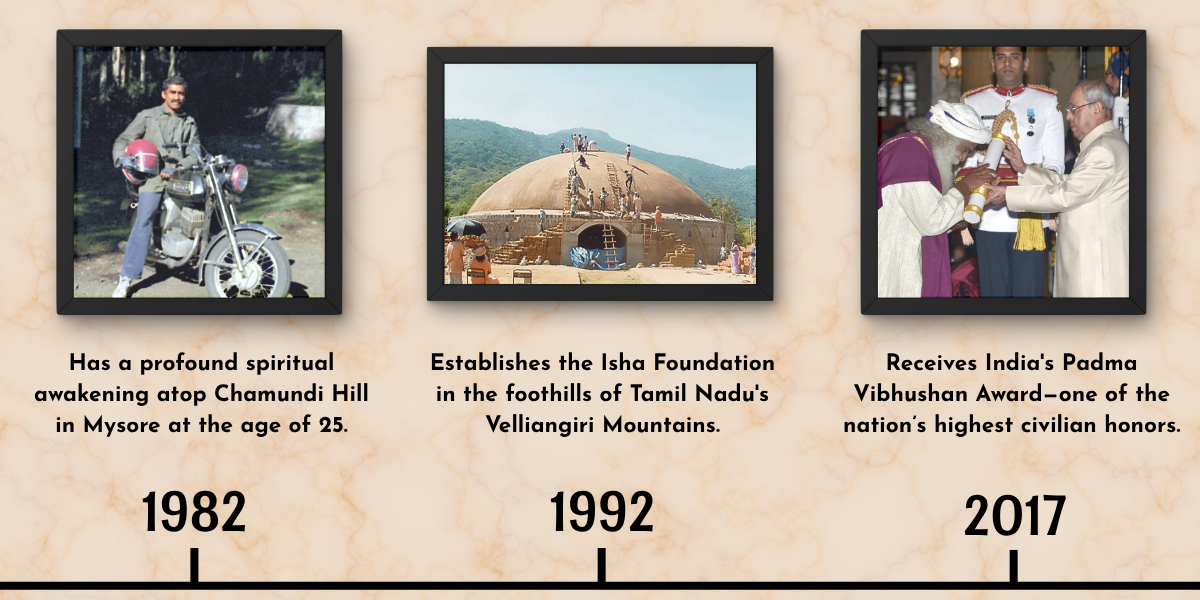
A pivotal turning point occurred on September 23, 1982. While seated atop Chamundi Hill in Mysore—a place he frequently visited—Vasudev experienced an intense state of expanded awareness. According to his own accounts, the boundaries between himself and his surroundings dissolved entirely, leaving a prolonged period of profound stillness and clarity. The experience lasted several hours and permanently altered his understanding of identity, perception, and consciousness.
In the weeks that followed, he withdrew from daily routines and reflected deeply on the implications of what had occurred. Concluding that his life could no longer be oriented solely around personal ambition, he entrusted his businesses to friends and embarked on an extended period of travel, meditation, and solitude. This year-long inward and outward journey eventually crystallized into a clear resolve: to share yogic tools that could allow others to explore the same dimensions of human experience.
In 1983, Vasudev conducted his first yoga program in Mysore with just seven participants. Over the following years, he traveled extensively across southern India on his motorcycle, offering programs freely and refusing personal payment. Donations were typically redirected toward charitable causes, reflecting a teaching approach grounded in service rather than institution-building.
In 1992, he formally established the Isha Foundation to support the growing scope of yoga programs and social initiatives. The following year, land was acquired at the foothills of the Velliangiri Mountains near Coimbatore—an area long revered within South Indian yogic culture. This site would later become the Isha Yoga Center, which opened fully to the public in 1999 and now serves as the foundation’s spiritual and administrative headquarters.
The center houses the Dhyanalinga, a consecrated meditative space rooted in classical yogic science, as well as the 112-foot Adiyogi statue, unveiled in 2017, symbolizing Shiva as the first yogi. Together, these structures reflect Isha’s emphasis on experiential spirituality rather than belief-based worship.
From the early 2000s onward, Sadhguru’s work took on an international dimension. He authored numerous books on yoga, inner well-being, and human potential, including Inner Engineering, which became a New York Times bestseller. He also began participating in major global forums, including the United Nations, World Economic Forum, and various interfaith and sustainability summits. In recognition of his contributions to spirituality, social outreach, and public discourse, the Government of India awarded him the Padma Vibhushan in 2017—one of the nation’s highest civilian honors.
Three of Sadhguru’s Most Influential Works
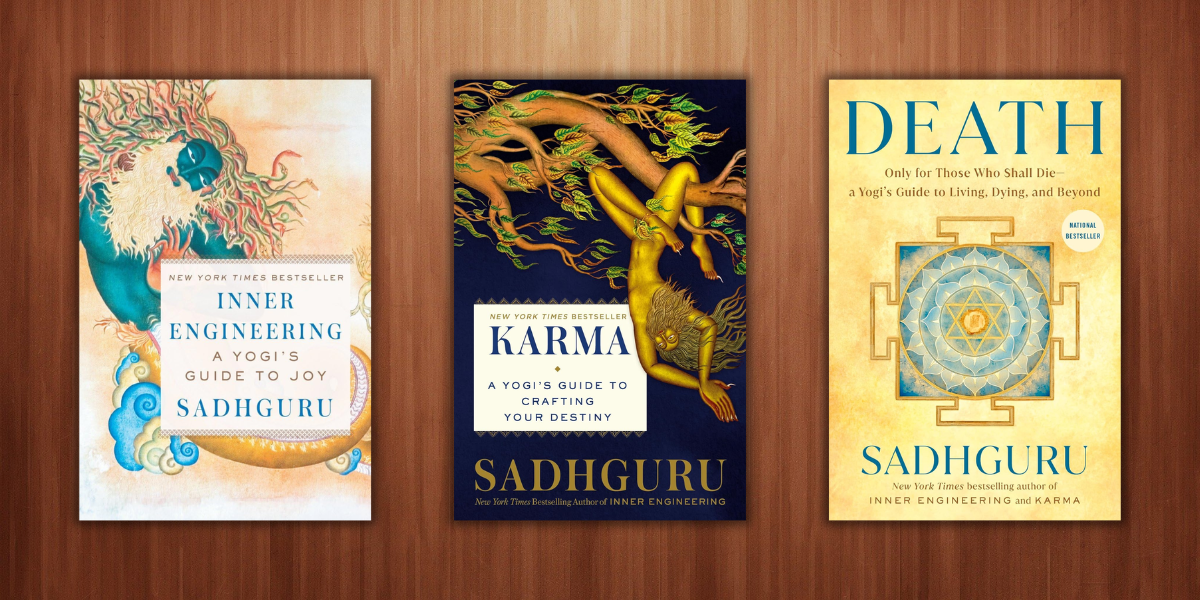
Among contemporary spiritual teachers, few have done more to introduce the principles of yoga and Hinduism to a global audience than Sadhguru. Through books, lectures, and his work at the Isha Foundation, he has presented ancient teachings in a modern, accessible language that resonates with millions of people worldwide. These three books highlight different dimensions of that message and showcase the distinctive blend of mysticism, practical wisdom, and spiritual inquiry that defines his work.
Inner Engineering (2016):
Part memoir, part spiritual guide, Inner Engineering: A Yogi’s Guide to Joy serves as one of the most comprehensive introductions to Sadhguru’s teachings. Blending stories from his own spiritual awakening with practical insights drawn from the yogic tradition, he argues that human well-being depends less on external achievements than on mastering one’s inner experience. The book became an international bestseller and introduced millions of readers to the possibility of using yoga as a tool for profound personal transformation. Sadhguru writes:
The whole effort of the spiritual process is to break the boundaries you have drawn for yourself and experience the immensity that you are. The aim is to unshackle yourself from the limited identity you have forged, as a result of your own ignorance, and live the way the Creator made you—utterly blissful and infinitely responsible.
Karma (2021):
In Karma: A Yogi’s Guide to Crafting Your Destiny, Sadhguru brings clarity to one of the most widely misunderstood spiritual concepts by challenging popular notions of cosmic reward and punishment, arguing instead that our thoughts, emotions, and behaviors are governed by the law of cause and effect. By reframing karma as a source of empowerment rather than predetermined destiny, the book invites readers to take greater responsibility for the direction of their lives. With endorsements from the likes of Tom Brady, Tony Robbins, and Will Smith, the bestselling book reveal Sadhguru’s immense global influence. He writes:
Karma simply means we have created the blueprint for our lives. It means we are the makers of our own fate. When we say “This is my karma,” we are actually saying “I am responsible for my life.”
Death (2025):
Every spiritual tradition eventually confronts the mystery of death, and in Death: Only for Those Who Shall Die—a Yogi’s Guide to Living, Dying, and Beyond, Sadhguru offers his most extensive exploration of the subject. Combining yogic teachings, personal experiences, and practical guidance, he examines death not as a tragic endpoint but as a natural transition within a larger continuum of existence. Both contemplative and practical, the book challenges readers to reconsider their assumptions about mortality and to live more consciously in light of life’s impermanence. Sadhguru writes:
When death comes knocking, all of a sudden, you will find this body does not mean anything. All your qualifications will not mean anything. Your husband, wife and children will not mean anything. Your fancy clothes will not mean anything. You will be hopeless. Like a vulture, I will wait for that moment, because, then, you will become willing. But if you are intelligent, if you have any sense in you, you will create that willingness right now.
20 Inspirational Jaggi Vasudev Quotes
If you can see every being as divine, the Earth is heaven. You do not need to know how to meditate. With absolute involvement, everything is Meditation.
Do not try to fix whatever comes in your life. Fix yourself in such a way that whatever comes, you will be fine.
From today onward, do not drag your feet. Dance your way through Life – whatever you are doing, whatever is happening.
Mind is madness. Only when you go beyond the Mind will there be Meditation.
The essence of spirituality is, to be constantly aware of the oneness of all; at the same time to celebrate the uniqueness of the individual.
Yoga means Union. Yoga also means ultimate empowerment. If you are in union with everything, it is a tremendous empowerment.
Consciousness is not a bunch of thoughts or a certain level of understanding. Consciousness is a dimension that is beyond our physicality.
The secret of life is to see everything with a Non-Serious eye, but to be Absolutely Involved. Like a sport. Involved, not entangled.
Looking at everything through your phone is only numbing your perception – it does not really enhance your experience of life in any way.
Believing means assuming something you do not truly know. Seeking means recognizing that you do not know.
We do not need an authority as Truth. Truth is the only authority.
Ignorance is not bliss. Ignorance is brutal. The brutality of ignorance is such that it will make you dead while alive.
If you pay Attention to the Life that you are, it will blossom within you.
Self-transformation is not just about changing yourself. It means shifting yourself to a completely new dimension of experience and perception.
Whether you walk or dance, work or play, cook or sing – do it with total awareness or with total abandon. Either way, you are one with creation.
A materialistic person is ruthless with other people but kind to himself. A spiritual person is ruthless with himself but kind to everybody else.
Through the prism of your thought, the whole world looks like a problem. Seen through the teardrops of your love and ecstasy, the whole world is a blessing.
How Profound your experience of life is, and how Impactful you are in what you do – this is all that matters in Life.
Do not try to be special. If you are simply ordinary, more ordinary than others, you will become extraordinary.
How to sit, how to stand, how to breathe, how to do everything, how your heart should beat, how the life within you should pulse – when you pay Attention to everything, you are in Yoga.
Affiliate Disclosure: Balanced Achievement earns a commission when books featured on our site are purchased through Amazon affiliate links. This comes at no additional cost to readers and helps support our work. All books are selected independently based on their quality, relevance, and editorial merit.

